共同研究論文(慶應義塾大学 石垣星先生)の採択について
 fukuneko
慶應義塾大学 石垣星先生との共同研究が、Immunological Medicine誌に採択されました。
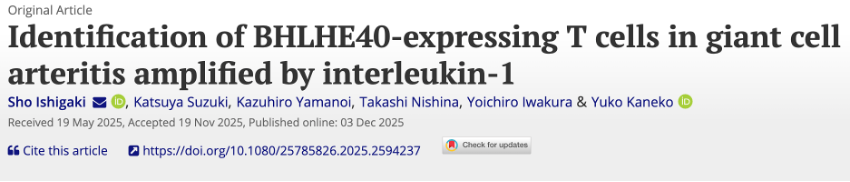
論文タイトル:“Identification of BHLHE40-expressing T cells in giant cell arteritis amplified by interleukin-1”
自己免疫疾患に関わる病原性T細胞を理解する上で重要な研究に、微力ながら貢献できたことを光栄に思います。石垣先生の研究の益々のご発展を祈念しております。
https://pubmed.ncbi.nlm.nih.gov/41340409
Acceptance of Collaborative Research Paper (with Dr. Sho Ishigaki, Keio University)
Our collaborative research paper with Dr. Sho Ishigaki from Keio University has been accepted for publication in Immunological Medicine.
Paper title: "Identification of BHLHE40-expressing T cells in giant cell arteritis amplified by interleukin-1"
Abstract: BHLHE40 is a transcription factor regulating proinflammatory cytokines such as granulocyte-macrophage colony-stimulating factor (GM-CSF) in CD4+ T cells. Although implicated in autoimmune inflammation, its regulation by interleukin (IL)-1 signaling in human CD4+ T cells remains unclear. Peripheral blood (PB) from healthy controls (HCs) and patients with giant cell arteritis (GCA) was analyzed using flow cytometry to assess BHLHE40 expression across helper T cells. Immunohistochemistry was performed on the aortas of IL-1 receptor antagonist knockout (IL-1Rn KO) mice and temporal artery biopsies from GCA patients. We also analyzed public microarray datasets and CD4+ T cells stimulated with anti-CD3/CD28 and IL-1β. We identified BHLHE40 expression in T cells in the IL-1Rn KO mice and GCA-inflamed arteries. BHLHE40 expression was higher in helper T subsets than in naïve CD4+ T cells. Co-stimulation with IL-1β and anti-CD3/CD28 induced stronger BHLHE40 expression than CD3/CD28 alone. Microarray data showed increased expression of BHLHE40 in CD4+ T cells from the PB of GCA patients. IL-1 signaling enhances BHLHE40 expression during CD4+ T cell activation. Its sustained expression in inflamed tissues suggests a disease-relevant pathway linking IL-1 signaling to pathogenic T cell responses in GCA.
I am honored to have contributed, albeit modestly, to this important research advancing our understanding of pathogenic T cells involved in autoimmune diseases. I wish Dr. Ishigaki continued success in his research endeavors.